
What Every Foodservice Operator Must Know About Written Employee Health Policy Requirement of the FDA Food Code
In our last blog, we established that while the FDA Food Code doesn’t explicitly require a written employee health policy, a verbal system is unverifiable, inconsistently applied, and leaves you with nothing to stand on when something goes wrong. We promised to come back with some advice on how to actually craft a policy that works.
Before you write a single line of policy, it helps to understand what you’re trying to accomplish. The employee health provisions in §2-201 of the FDA Food Code exist to interrupt one specific chain of events: an infected employee making contact with food or food-contact surfaces which then cause a customer to fall ill. Every element of a well-designed health policy is aimed at breaking that chain as early as possible. The earlier you identify a potentially infectious employee, the more control you have.
The goal of your policy is to create a system where:
- Employees know exactly what symptoms and diagnoses they are required to report.
- Employees feel safe reporting without fear of punishment or job loss.
- The Person in Charge knows what to do the moment a report comes in.
- The decision to restrict or exclude is based on consistent criteria, not judgment calls.
- Documentation exists to demonstrate that the system was followed.
Keep these five items in front of your mind as you write. Every section of the policy should serve one of those five items.
A complete policy doesn’t need to be complicated. But it does need to cover seven things:
- To whom does the policy apply?
- What symptoms require reporting?
- What diagnoses and exposures require reporting?
- How and when are employees expected to report?
- What happens after a report (restriction vs. exclusion)?
- How are employees able to return to work after reporting?
- An acknowledgment signature that the employee has read and understood the policy.
Some of these items may take a paragraph; others may take a page. None of them are optional.
To whom does the policy apply?
Your policy covers everyone working in a food-handling capacity. This includes full-time, part-time, seasonal, temporary, and contracted staff. It also applies to conditional employees: applicants who’ve been offered a position but haven’t started yet. If an applicant discloses a covered diagnosis during pre-employment screening, they cannot begin working until reinstatement criteria are met. If your policy doesn’t explicitly include them, they aren’t covered.
What symptoms require reporting?
Five symptoms require an employee to notify the Person in Charge before or during their shift: diarrhea, vomiting, jaundice (yellowing of the skin or whites of the eyes), sore throat with fever, and infected wounds on the hands or wrists that cannot be effectively covered.
Write these in plain language your team uses. Most employees don’t know what jaundice means, so describe it. And be clear that vomiting and diarrhea are exclusion triggers, not reassignment triggers.
What diagnoses and exposures require reporting?
Employees must report a diagnosis of any of the six covered pathogens: norovirus, hepatitis A, Salmonella Typhi, STEC, Shigella, or nontyphoidal Salmonella, regardless of whether they currently have symptoms.
They must also report exposure through a household member’s diagnosis or through food they consumed that’s linked to an outbreak. This exposure-based requirement surprises many operators and employees alike, which is exactly why it needs to be spelled out in writing.
How and when employees are expected to report.
Your policy should specify who the employee contacts (the Person in Charge by role, not just “management”), when the report must happen (before the shift begins, not after arriving), how it should be made (phone call, text, in person, use whichever works for your operation), and what information to provide. The easier you make reporting, the more likely employees will do it when they’re sick, stressed, and worried about money.
What happens after a report (restriction vs. exclusion)?
When a report comes in, the person in charge needs to know immediately which response it requires. There are two options: exclusion or restriction, and this is often based on two additional considerations. First, if the employee is symptomatic (experiencing symptoms) or asymptotic (not yet experiencing symptoms), and second, if the business deals with a high-risk population or not.
In general, exclusion (making the individual leave the operation and return home) applies to active vomiting or diarrhea, jaundice, and any diagnosis of hepatitis A, STEC, Shigella, Salmonella Typhi, or nontyphoidal Salmonella if the employee is experiencing symptoms.
…If an employee is excluded, they cannot be in the establishment while food is being prepared or served. Period. Reassigning them to the dish pit doesn’t count…
For a more thought discussion on the exclusion vs. restriction decision, check out our previous blog on the topic. Restricting the employee to work in areas with no exposed food or food-contact surfaces applies to sore throat with fever, uncoverable infected wounds on the hands, and exposure to a covered illness through a household member with no current symptoms. Define what restriction looks like in your operation before you need to make that call mid-service.
How are employees able to return to work after reporting.
Employees need to know there’s a clear path back to work, or the policy will discourage reporting. For vomiting or diarrhea without a confirmed diagnosis, symptom-free for the period your jurisdiction requires (commonly 24 hours) is the general standard. But always verify your local jurisdiction’s specific requirements, they may differ from the model Food Code.
An acknowledgment signature that the employee has read and understood the policy.
Every employee must sign and date the policy confirming they received it and understand their reporting obligations. Keep signed copies on file, give employees their own copy, and collect new signatures any time the policy is updated. This documentation is your evidence of compliance.
When writing the policy, be sure to write at a clear, accessible reading level. If you wouldn’t use the word in a pre-shift meeting, don’t use it in the policy.
Be specific and define terms. If you use “jaundice,” define it. If you use “restriction,” explain what it means in practice.
If a significant portion of your team is more comfortable in a language other than English, translate the policy. The FDA and many state health departments offer free translated versions of employee health materials. Use them.
A written employee health policy does not need to be a complicated document. It is a clear, practical system that is put into writing and communicated to your employees what to report, tells your managers what to do, and tells your regulatory authority that you take this seriously. It won’t prevent every foodborne illness, but it will give you the best possible chance of catching a risk before it becomes an outbreak. Risk Nothing.
READ MORE POSTS

Handling Leafy Green Salad
We have had several produce outbreaks of foodborne disease from our lettuce, spinach, and other greens in the last several years that have been devastating to the produce growers and distributors, retail grocery stores, restaurants, and consumers.
Food Packaging Safety in a Vacuum
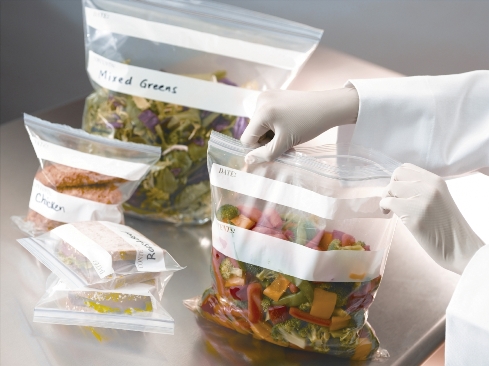
Extending the shelf life of fresh foods has come a long way in the food industry since curing meats with salt and sugar or canning vegetables with heat processing. The food service and consumer markets needed some better visual packages to draw the eye to the freshness factor and the technology of food packaging has filled our dinner plate. Vacuum packaging and modified atmosphere packaging, shortened to “MAP”, are the terms used for the method of food packaging used every time we choose convenience over more complex scratch meal preparation. According to industry statistics, billions of packages of vacuum and MAP-packaged foods flood the marketplace today. In both modified-atmosphere and vacuum packaging, food is packaged in a pouch made of barrier film.

The Eleven Commandments of Food Safety at Your Restaurant
Lists help us remember all kinds of information. Given the list of recent national foodborne outbreaks in the news, keep repeating this list to your food service team. They are kind of like “commandments”. As a professional in a food service facility we should think of the very basic food safety concepts that every crew member should aspire to learn, even though this list may have different priorities based on your menu. The first 3 apply to anyone who serves food, from a bag of popcorn to a full course meal. As chefs or managers, if we can “set the example” by repeating good food safety practices visibly to the crew, it will help them understand how important it is to the success of your facility. Thou shalt:

The Worst Customer Complaint: Foodborne Illness
Food service managers and crew try to follow the rules of food protection. Yet, occasionally a complaint may arise and these calls take priority over all other daily crises. If you have been in the food service industry long enough, you may have gotten one of these. A customer may claim, "I think your food made me ill." These words inflict instant anxiety. If it happens, here are some next steps to think about in advance of such a claim: