
The 2026 Food Code Is Here: What Actually Changed for Your Kitchen? (and What Hasn’t Yet)
On September 17, 2026, the FDA released the 2026 Food Code, the first full edition since 2022. Several changes will reach every kitchen line, tray line, and cafeteria once your jurisdiction adopts them in the coming years.
Call it our Hambamus papam moment. Ok, so maybe we don’t have a new Pope, and there is no white smoke over the Sistine Chapel, just a long document from the FDA. But for foodservice operators and food safety folks like me, announcing a new Food Code is about as close as we get to announcing a new Pope. Just like when a new Pope is announced, everyone wants to know who it is and what’s going to change; the same is true with our food code, at least for those in the business of serving food to the public in some form or fashion.
Anyone can go look at the 2026 Model Food Code online and the FDA also posts a summary of the changes. The FDA makes these available for anyone and everyone who is interested. But to save you an hour or two of digging through the code and summary, I’ve provided an update below of the major changes. There were many changes to the code, but much of it was cleanup: updating URLs, ensuring that it meets web accessibility requirements, and better explaining things that might have been confusing in previous editions. But, some of them will impact your operations when they are adopted in your jurisdiction.
Remember, the food code is a model. I have said this before in these blogs, and I always like to round out our SafeBites webinars with that reminder. Your state, county, or tribal health authority decides whether and when to adopt the model food code, and many jurisdictions are still on the 2017 or 2022 editions. It will likely be several months or a year before your local jurisdiction adopts the new food code. Check with your local health department before rewriting policies. Still, these changes show where inspections may be heading.
…the food code doesn’t become law the day FDA publishes it. But the operators who start preparing now won’t be scrambling when their state adopts it…
Written Employee Illness Policy Required
In earlier posts, we’ve covered why Standard Operating Procedures and illness policies matter. The 2026 Food Code now makes that guidance a formal requirement. Part 2-5 has been renamed “Policies and Procedures for Employee Illness Management,” and permit holders must now have a written employee illness policy on file and be ready to show it to inspectors when asked. Procedures for cleaning up vomit and diarrhea have moved to their own section, 2-502.11. The FDA has also updated its model inspection form: the related item is now called “Illness Documentation” and is classified as a Priority Foundation item, so gaps here carry real weight during an inspection. Now is a good time for operators to review their current procedures for reporting and excluding sick employees, making sure they’re written down, up to date, and easy to pull up when an inspector visits.
Flexibility Added to Return-to-work Testing
For employees diagnosed with STEC, Shigella, or non-typhoidal Salmonella, two negative stool cultures are no longer the only path back to work. Two consecutive negative results from a validated test at an accredited lab now qualify, which allows newer diagnostic methods. While this may not be an earth-shattering move for our operators, it does make that return to work a bit easier to navigate, especially for our operators in rural areas.
A Written Food Safety Management System
This is the biggest structural change to the code. Under section 8-201.15, within four years of a jurisdiction adopting the 2026 Code, covered establishments must have a written Food Safety Management System (FSMS). It must be in use during all hours of operation and available to the regulator. Minimal-risk operations can be exempted at the description of the jurisdiction.
So, what does the code say should go into the FSMS? Well, stay tuned, because that section of the code, which will be included in section 8-201.16 has not yet been established and will be forthcoming. Likely in supplements to the food code that will be published in future years.
Active Managerial Control is a Duty
Active managerial control is not a new addition to the food code; we’ve seen it mentioned in the code for the last several years. What is new to the 2026 code is that the person in charge also has an explicit duty to maintain active managerial control: making sure requirements are met, not just known. The FDA has encouraged it for years to get ahead of the five main causes of foodborne illness: food from unsafe sources, inadequate cooking, improper holding temperatures, contaminated equipment, and poor employee hygiene. Rather than waiting for an inspector to find a problem, operations practicing AMC build routines that catch deviations from food safety standards before they become an actual problem.
What does this mean practically for operators? Well, food safety certification is still important, but if you have a certified food safety manager on each shift, and still don’t “manage” food safety, you will not be satisfying the requirements of the code.
Food Defense Enters the Code
“Food Defense,” protecting food from intentional contamination, is now defined at the start of the code. The code also added food defense as an additional area that the person in charge must understand and make sure employees are trained.
Double Gloving, with Approval
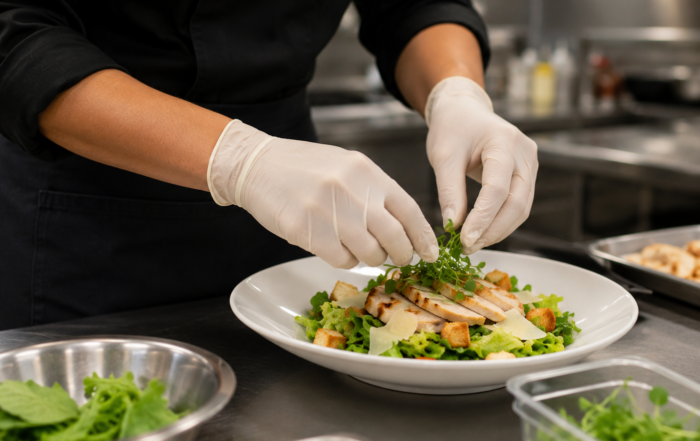
From my recollection, this is the first time double gloving has been mentioned in the food code. Previously, the food code required a single use glove to be used for only one task. But now double gloving is permitted, when approved. If you’re not familiar with double gloving, this is when employees may wear a task-specific, loose-fitting outer glove over a single-use inner glove. Language on discarding damaged or soiled gloves is also tightened. But it is important to note that this is only allowed with regulatory approval.
New cooling options
The code adds cooling in uncovered pans at a depth of 2 inches or less as an option for cooling. Regulators may also approve an alternative cooling method for cooked TCS food, such as refrigeration with continuous electronic monitoring of time and air temperature. But none of these change our previous discussions and recommendations in these blogs, whatever cooling method you use document it and make sure it works.
Jewelry on Arms and Hands
There has been a little bit of a grey area in the code related to jewelry on the arms and hands. The 2022 food code, in section 2-303.11 stated, “Except for a plain ring such as a wedding band, while preparing FOOD, FOOD EMPLOYEES may not wear jewelry including medical information jewelry on their arms and hands.” Well, line cooks and others argued that smart watches were not jewelry; they were necessary devices to aid in their work. Well, the 2026 food code has attempted to remove any ambiguity and now, stating that only “a plain ring, such as a wedding band, may be worn.”.
While we didn’t cover every change in the food code, I selected the changes that I predict would have the biggest impact on you and your operations. It is important to remember, the Food Code doesn’t become law the day FDA publishes it. But the operators who start preparing now won’t be scrambling when their state adopts it. Risk Nothing.
READ MORE POSTS
The Hidden Danger of Kitchen Biofilms
In previous blogs, we discussed why cleanliness is not always safe in the kitchen of [...]
Transitioning Your Kitchen from ‘Visually Clean’ to ‘Code Compliant’
A few years ago, as part of a larger food safety research grant, our research [...]
Building an Internal Food Safety Audit Process
I can’t speak for you all, but one of the moments I always hated in [...]
The FDA Food Code Requirement for the Person in Charge
Every restaurant has someone running the show during any given shift. The FDA Food Code [...]