
HACCP Doesn’t Have to Be All or Nothing: Even Incremental Changes Can Have a Big Impact on your Food Safety Program
Most foodservice operators hear Hazard Analysis and Critical Control Point, otherwise known as “HACCP,” and picture binders full of flowcharts, scientific analyses, and regulatory paperwork. And while a full, formal plan can start to look exactly like that, the truth is that you don’t have to implement the entire system to benefit from HACCP principles. Even adopting pieces of the framework will reduce your risk of a foodborne illness outbreak.
Our colleagues who manage school foodservice operations are already well-versed in HACCP systems. School foodservice authorities participating in the National School Lunch or National School Breakfast program had to implement HACCP systems over 20 years ago. For those who don’t quite recall the fundamentals of HACCP, it is a systematic, science-based approach to identifying where biological, chemical, and physical hazards can impact your foodservice operation. Then, putting controls in place to prevent, eliminate, or reduce those hazards to safe levels. It was originally developed for NASA’s space food program and has since become the global gold standard for food safety.
The system is built around seven core principles: conducting a hazard analysis, identifying critical control points (CCPs), establishing critical limits, setting up monitoring procedures, defining corrective actions, implementing verification, and maintaining documentation.
…Perfect is the enemy of good in food safety…
If you’re running a restaurant, a catering company, a senior living dining program, or any other foodservice operation without a formal HACCP plan, you can still harness the power of this system right now. Here are a few ideas to get started:
Perfect is the enemy of good in food safety. A foodservice operation that monitors temperatures religiously, trains staff on handwashing and cross-contamination, and documents corrective actions is dramatically safer than one waiting to implement a “perfect” HACCP plan someday. Start with your highest-risk foods, build simple monitoring habits, and document what you do. Risk Nothing.
READ MORE POSTS

Be Proactive and Don’t End Up in Food Safety Jail!
Ok, I admit – there really is no food safety jail. But there is jail and, while it is uncommon, you can be sent there for not practicing food safety. Just the other day, I ran across a news report about two individuals in Wales who were sent to jail (albeit a suspended sentence) for “failing to take action to protect food from the risk of contamination; placing unsafe food on the market; failing to comply with a Remedial Action Notice and operating the business without approval after permission to supply seafood was suspended.”
Was that last 24 Hour “Bug” You Had Really a Foodborne Illness in Disguise?
Within this blog, I have discussed many foodborne pathogens: E. coli, Hepatitis, Salmonella, Listeria monocytogenes, and Campylobacter. But we’ve somehow managed to omit Staphylococcus aureus (S. aureus).
30 Years Later: The Foodborne Illness Outbreak that Changed Food Safety
In January, we hit a major anniversary. One I am betting snuck by many of you – including me! January marked 30 years since the deadly 1993 E. coli O157:H7 outbreak at Jack in the Box restaurants on the west coast. The anniversary wasn’t on any of the major news networks that I recall. It did make it into a few newspapers, at least one or two of the newspapers that are left. It wasn’t until late-February that I realized it.
Does Temperature Really Matter when Washing your Hands?
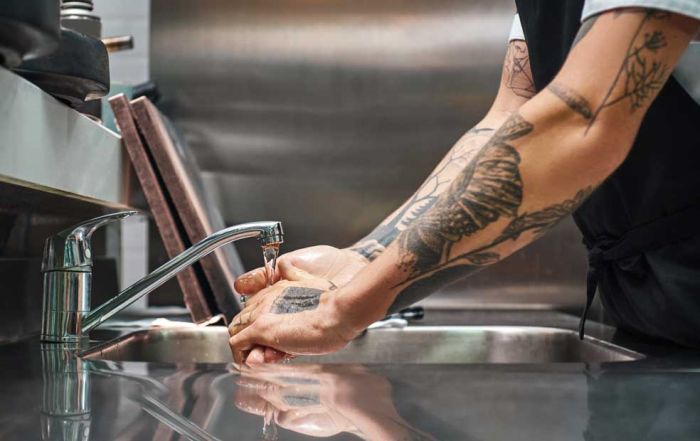
In January, I reviewed the changes to the 2022 Food Code in my blog (check out Part I and Part II), and one change to the food code that I had mentioned, but didn’t discuss in-depth, was the change that lowered the water temperature a hand sink was required to produce to 85°F, as noted in Section 2-202.12 of the code. This requirement has been in place since the publishing of the 2001 Food Code, which required a water temperature of 100°F. Prior to this, 110°F was required (see the 1999 Food Code). So why the change and does water temperature when washing your hands really matter?