
Decoding the Consumer Advisory Requirement
When designing a menu featuring items such as a medium-rare steak, eggs cooked sunny-side-up, or a tuna tartare, the culinary presentation and the item’s profit margins are often the most important considerations. However, failing to provide the consumer advisory required for these dishes can result in an automatic health code violation.
To remain fully compliant with regulatory standards, retail foodservice operations that serve raw or undercooked animal foods must properly format and display a Consumer Advisory, which is outlined in Section 3-603.11 of the 2022 FDA Food Code, Consumption of Animal Foods that are Raw, Undercooked, or Not Otherwise Processed to Eliminate Pathogens.
According to the code, if an animal food, such as beef, eggs, fish, lamb, pork, poultry, or shellfish, is served or sold raw, undercooked, or without being processed to eliminate pathogens, the foodservice operation must inform consumers of the increased health risk. To satisfy this, your menu or setup must incorporate two distinct structural components:
- The Disclosure: A written statement that clearly identifies the animal-derived foods that are, or can be ordered, raw, undercooked, or without otherwise being processed to eliminate pathogens. This must be specific and developed from your menu, for example, Caesar Salad, hamburgers, or whatever items you have on your menu that can be ordered raw, undercooked, or without food preservation.
- The Reminder: Under the FDA Food Code, consumer advisory reminders must link raw or undercooked animal foods to a footnote that warns of increased foodborne illness risks, either generally or for vulnerable populations, or alternatively states that written safety information is available upon request.
…failing to provide the required consumer advisory for raw or undercooked dishes can result in an automatic health code violation…
Operators have flexibility in how they display disclosures on their menus. Executing the consumer advisory requires a balance between regulatory compliance and guest experience. Common methods include explicitly describing the items within the menu text, such as “Oysters on the half shell (raw)”, “Caesar Salad (uncooked egg)”, or “Ribeye steak (cooked to order)” or attaching a symbol (like an asterisk) directly next to the menu item name to link it to a footnote.
If you use the asterisk method, it must point directly to a reminder footnote at the bottom of the menu. While the exact wording can vary slightly depending on state and local health department adoptions, a widely accepted standard that is pulled from the food code itself reads: “Consuming raw or undercooked meats, poultry, seafood, shellfish, or eggs may increase your risk of foodborne illness, especially if you have certain medical conditions.” Be sure the font size of your footnote is legible. Health inspectors frequently cite menus in which the consumer advisory text is reduced to unreadable fine print at the very bottom margin.
Hard-copy menus used in the operation are not the only place guests view your offerings. If your establishment utilizes digital displays, online ordering platforms, QR code menus, or third-party delivery apps, the consumer advisory must be visible there as well. Ensure your website or ordering portal clearly displays the required disclosure and reminder text before a customer can finalize checkout.
If your concept changes its menu daily or writes specials on a chalkboard, printing new menus constantly is impractical. The Food Code allows alternative posting methods when menus are absent, such as brochures, table tents, or clearly visible notices displayed at the point of ordering.
A consumer advisory is more than just a box to check for a health inspector; it is a vital communication tool that protects both your guests, especially highly susceptible populations, and your business liability. Review your menus today to ensure your disclosures and reminders are properly paired, easy to read, and fully aligned with Section 3-603.11 Risk Nothing.
READ MORE POSTS

Meat Color and Doneness: Persistent Pinking
Late in June, my family and I were able to visit the Black Hills, an area of the country in which I have not had the opportunity to spend much time. One evening, as we dined at a local restaurant, I observed a table across the dining room sending back a dinner. While I couldn’t hear the entire conversation and I certainly wasn’t trying to eavesdrop, it was apparent that the customer was unhappy with the cooking of their hamburger and was sending it back because it was too pink in the middle. That immediately brought to my mind the phenomenon known as persistent pinking. A term I became familiar with because of work done by some colleagues here at Kansas State, which they present each summer to a group of foodservice operators who join us on-campus for an in-depth week-long look at all things food safety.

Quat Binding – Why this Can Have a Disastrous Impact on Your Sanitation Program.
In June, I had the opportunity to represent FoodHandler and speak on food safety behavior for customers of Martin Bros. Distributing in Waterloo, Iowa. One of the questions that was asked caught me a little off guard. The question was about quat binding. It caught me off guard not because it was a bad question, but only because it was not something I had previously been asked nor had not yet been exposed to the phenomenon. However, I soon learned that in certain jurisdictions, it is resulting in changes to how sanitizing cloths are to be stored in sanitizing buckets (or not) in the foodservice industry. When I returned home from the trip, I had to dig into it to learn about what quat binding is and how it might impact foodservice operations.
Are Grades for Foodservice Inspections a Good Idea?
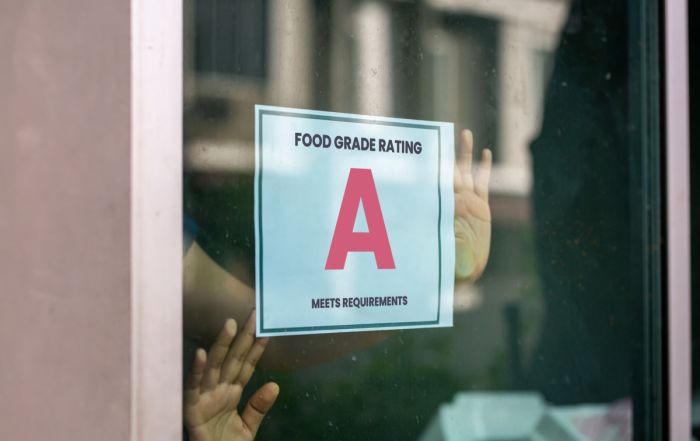
I generally try to stay away from controversial topics in my blog, but this is one I thought it might be interesting to discuss. Occasionally on my travels, I will come across a state or a local jurisdiction that requires foodservice inspection scores be posted in the window of the establishment. The idea is to allow would-be customers the ability to see how the foodservice operation in which they are about to eat scored on their latest health inspection.

Neglected Safety: CDC Report Casts Doubts on the Ability of the Foodservice Industry to Ensure Ill Workers Stay at Home
Early in June, the Centers for Disease Control and Prevention released a report outlining foodborne illness outbreaks in retail foodservice establishments. The report outlined outbreaks from 25 state and local health departments from 2017 through 2019.