

Accountability Supports Food Safety Culture
With the low unemployment numbers, and competition for good workers, many managers may choose to look the other way when staff do not complete tasks when and how they should. You may recall the parent who tells the little scamp, I’m going to count to three – one, two, two and a half, two and three quarters, etc. – only to find there is no change in behavior. That little scamp may well end up in juvie because he/she was never held accountable for behavior – the parents always looked the other way just to keep the peace. But a failure to act has unintended consequences, not just for the child, but for others in the family. It is the same in any foodservice operation–lack of consistent adherence to defined and communicated ways of work can result in a free for all or someone going rogue. From there, a positive food safety culture can only go downhill because operational values are not being acted upon, and other employees (the good ones) may get frustrated and leave to work in a place where they feel valued.
Our research at Iowa State found that employees wanted to be rewarded when they did things right, and wanted employees who didn’t follow the rules to have consequences for their actions. With USDA funding, we created modules for managers to assist in developing infrastructure. In a nutshell, the recipe is not too difficult.
First, establish what and how the work should be completed. This is where the operation’s written standard operating procedures (SOPs) and employee policies play a role. Second, establish in advance what consequences there will be for failure to follow. At the same time, an operation could consider a rewards or incentive program for good performance. Some operations gather ideas from the leadership team only and others seek input from all staff in an effort to get buy-in. A consideration in this process is that the consequences and rewards are appropriate for the action: firing someone for being late after one offense might be too drastic but the team may decide firing someone after three unexcused absences is not. What is important is that once consequences are decided upon, there is consistency in implementing. That is what gives the backbone to any system. When the manager counts to three, it is done so the same way each time! Consistency in providing rewards is also important to avoid charges of favoritism. Managers will want to log when consequences are imposed to ensure a record is maintained in the event there is a legal challenge.
Documentation of the SOPs, employee policies, consequences for failure to follow, and training on these topics supports a positive food safety culture and is a risk mitigation strategy. Risk Nothing!
READ MORE POSTS

Routes of Foodborne Illness & Germs
From your sniffling coworker to the raw chicken on your kitchen cutting board, everyday life is full of potential infectious hazards. With germs so common and seemingly everywhere, knowing how germs spread is vital to preventing infection and foodborne illness. There are seven possible ways for the transmission of bacteria and viruses to take place. Although some of these microorganisms in our environment are good for us and protect us, disease causing pathogens are the germs or bad guys.

Handling Leafy Green Salad
We have had several produce outbreaks of foodborne disease from our lettuce, spinach, and other greens in the last several years that have been devastating to the produce growers and distributors, retail grocery stores, restaurants, and consumers.
Food Packaging Safety in a Vacuum
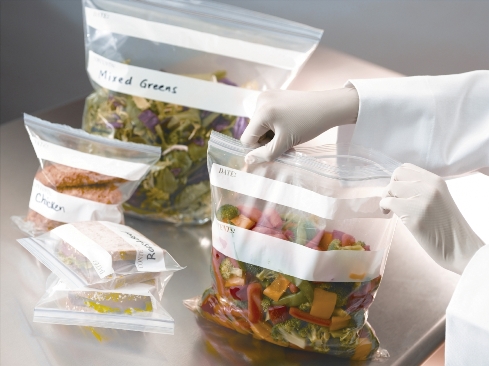
Extending the shelf life of fresh foods has come a long way in the food industry since curing meats with salt and sugar or canning vegetables with heat processing. The food service and consumer markets needed some better visual packages to draw the eye to the freshness factor and the technology of food packaging has filled our dinner plate. Vacuum packaging and modified atmosphere packaging, shortened to “MAP”, are the terms used for the method of food packaging used every time we choose convenience over more complex scratch meal preparation. According to industry statistics, billions of packages of vacuum and MAP-packaged foods flood the marketplace today. In both modified-atmosphere and vacuum packaging, food is packaged in a pouch made of barrier film.

The Eleven Commandments of Food Safety at Your Restaurant
Lists help us remember all kinds of information. Given the list of recent national foodborne outbreaks in the news, keep repeating this list to your food service team. They are kind of like “commandments”. As a professional in a food service facility we should think of the very basic food safety concepts that every crew member should aspire to learn, even though this list may have different priorities based on your menu. The first 3 apply to anyone who serves food, from a bag of popcorn to a full course meal. As chefs or managers, if we can “set the example” by repeating good food safety practices visibly to the crew, it will help them understand how important it is to the success of your facility. Thou shalt: