
Resolve to Protect: Why This Year’s #1 Priority Should Be Food Safety
The new year presents foodservice managers with a wonderful opportunity to reset, refocus, and recommit to what matters most: protecting the health of every student, guest, patient, resident, or customer who dines in their establishment. As a manager or owner, there’s no better time than now to evaluate your food safety culture and strengthen your team’s dedication to safe food handling practices.
Food safety culture goes beyond simply following health codes or passing inspections. It’s the collective attitudes, beliefs, and behaviors that your entire team shares about food safety. When food safety is truly embedded in your establishment’s culture, it becomes automatic. It is not just something employees do because they were told to do so, but because they understand how important it is to everyone: owners, managers, and their fellow employees.
A strong food safety culture protects your customers, safeguards your reputation, reduces liability, and creates a professional environment where employees take pride in their work. A strong food safety culture forces managers to lead by example. I often use the example of handwashing. If managers continually remind employees to wash their hands, but they themselves don’t wash their hands when they first step into the kitchen, they have shown employees that food safety isn’t a priority. They are not leading by example! When managers lead by example and prioritize food safety, the entire team follows suit.
Before you can recommit, you need to honestly assess your current food safety culture. Ask yourself these questions:
- Do you have established SOPs that address basic food safety operations?
- Do employees consistently wash their hands at proper times, or do they take shortcuts when they think no one is watching?
- Are temperature logs completed accurately and on time, or filled in hastily at the end of shifts?
- When someone identifies a food safety concern, do they feel comfortable speaking up?
Are these the only questions you should ask yourself to ensure you have a food-safe culture? Certainly not! But the answers to these questions will help to determine whether food safety is prioritized in your operation or merely treated as a box-checking exercise. Remember, this assessment isn’t about finding all the faults of your business. It is about identifying opportunities for growth in your food safety culture and programs.
…this assessment isn’t about finding all the faults of your business…it’s about identifying opportunities for growth in your food safety culture and programs…
Whatever goals you establish, write them down and share them with your entire team, not just the management team. Then, revisit them quarterly to track progress. Post visual reminders throughout your kitchen. Integrate food safety discussions into every staff meeting. Consider appointing food safety champions among your team who can help maintain standards and mentor newer employees.
As a manager, you set the tone for food safety culture. Your team watches everything you do. If you skip handwashing, ignore temperature checks, or make excuses for cutting corners during busy periods, your employees will mirror these behaviors regardless of what your training materials say.
Recommit to being the food safety leader your establishment needs. Stay engaged with your food safety program, observe employee behaviors, and provide immediate, constructive, and positive feedback.
At FoodHandler, we are re-committing ourselves to help you maintain and strengthen your food safety program, too! For the last several years, FoodHandler has sponsored quarterly webinars with our food safety experts to help you stay informed. This year, we are upping the ante and bringing you six webinars to help you keep your food safety programs top of mind! Check out our upcoming SafeBites Food Safety Webinars, all to bring you the most current information about food safety.. Risk Nothing.
READ MORE POSTS

Embracing Technology for Enhanced Food Safety in Foodservice Operations
Technology. We love it, we hate it. I’ve always been fascinated by technology; I remember getting my first Blackberry in the mid-90s and thinking it was the pinnacle of technological advances. Before that, I remember ordering a dictation program in college that was going to revolutionize the way I “typed” my assignments. Looking back, it really wasn’t worth the box that the program came in. Now, we have ChatGPT that will write the entire paper for us!

Meat Color and Doneness: Persistent Pinking
Late in June, my family and I were able to visit the Black Hills, an area of the country in which I have not had the opportunity to spend much time. One evening, as we dined at a local restaurant, I observed a table across the dining room sending back a dinner. While I couldn’t hear the entire conversation and I certainly wasn’t trying to eavesdrop, it was apparent that the customer was unhappy with the cooking of their hamburger and was sending it back because it was too pink in the middle. That immediately brought to my mind the phenomenon known as persistent pinking. A term I became familiar with because of work done by some colleagues here at Kansas State, which they present each summer to a group of foodservice operators who join us on-campus for an in-depth week-long look at all things food safety.

Quat Binding – Why this Can Have a Disastrous Impact on Your Sanitation Program.
In June, I had the opportunity to represent FoodHandler and speak on food safety behavior for customers of Martin Bros. Distributing in Waterloo, Iowa. One of the questions that was asked caught me a little off guard. The question was about quat binding. It caught me off guard not because it was a bad question, but only because it was not something I had previously been asked nor had not yet been exposed to the phenomenon. However, I soon learned that in certain jurisdictions, it is resulting in changes to how sanitizing cloths are to be stored in sanitizing buckets (or not) in the foodservice industry. When I returned home from the trip, I had to dig into it to learn about what quat binding is and how it might impact foodservice operations.
Are Grades for Foodservice Inspections a Good Idea?
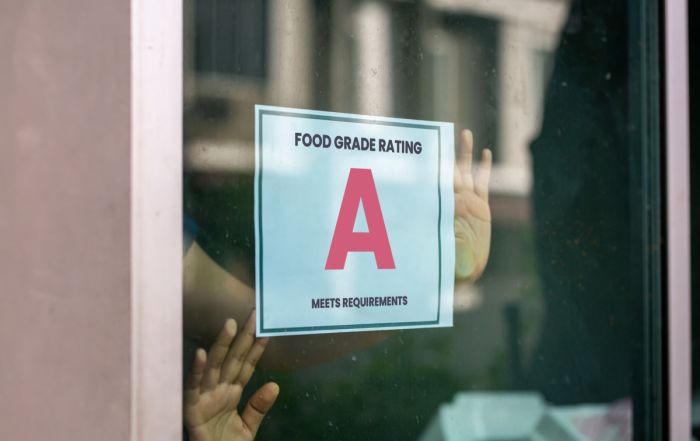
I generally try to stay away from controversial topics in my blog, but this is one I thought it might be interesting to discuss. Occasionally on my travels, I will come across a state or a local jurisdiction that requires foodservice inspection scores be posted in the window of the establishment. The idea is to allow would-be customers the ability to see how the foodservice operation in which they are about to eat scored on their latest health inspection.