
HACCP Doesn’t Have to Be All or Nothing: Even Incremental Changes Can Have a Big Impact on your Food Safety Program
Most foodservice operators hear Hazard Analysis and Critical Control Point, otherwise known as “HACCP,” and picture binders full of flowcharts, scientific analyses, and regulatory paperwork. And while a full, formal plan can start to look exactly like that, the truth is that you don’t have to implement the entire system to benefit from HACCP principles. Even adopting pieces of the framework will reduce your risk of a foodborne illness outbreak.
Our colleagues who manage school foodservice operations are already well-versed in HACCP systems. School foodservice authorities participating in the National School Lunch or National School Breakfast program had to implement HACCP systems over 20 years ago. For those who don’t quite recall the fundamentals of HACCP, it is a systematic, science-based approach to identifying where biological, chemical, and physical hazards can impact your foodservice operation. Then, putting controls in place to prevent, eliminate, or reduce those hazards to safe levels. It was originally developed for NASA’s space food program and has since become the global gold standard for food safety.
The system is built around seven core principles: conducting a hazard analysis, identifying critical control points (CCPs), establishing critical limits, setting up monitoring procedures, defining corrective actions, implementing verification, and maintaining documentation.
…Perfect is the enemy of good in food safety…
If you’re running a restaurant, a catering company, a senior living dining program, or any other foodservice operation without a formal HACCP plan, you can still harness the power of this system right now. Here are a few ideas to get started:
Perfect is the enemy of good in food safety. A foodservice operation that monitors temperatures religiously, trains staff on handwashing and cross-contamination, and documents corrective actions is dramatically safer than one waiting to implement a “perfect” HACCP plan someday. Start with your highest-risk foods, build simple monitoring habits, and document what you do. Risk Nothing.
READ MORE POSTS

Embracing Technology for Enhanced Food Safety in Foodservice Operations
Technology. We love it, we hate it. I’ve always been fascinated by technology; I remember getting my first Blackberry in the mid-90s and thinking it was the pinnacle of technological advances. Before that, I remember ordering a dictation program in college that was going to revolutionize the way I “typed” my assignments. Looking back, it really wasn’t worth the box that the program came in. Now, we have ChatGPT that will write the entire paper for us!

Meat Color and Doneness: Persistent Pinking
Late in June, my family and I were able to visit the Black Hills, an area of the country in which I have not had the opportunity to spend much time. One evening, as we dined at a local restaurant, I observed a table across the dining room sending back a dinner. While I couldn’t hear the entire conversation and I certainly wasn’t trying to eavesdrop, it was apparent that the customer was unhappy with the cooking of their hamburger and was sending it back because it was too pink in the middle. That immediately brought to my mind the phenomenon known as persistent pinking. A term I became familiar with because of work done by some colleagues here at Kansas State, which they present each summer to a group of foodservice operators who join us on-campus for an in-depth week-long look at all things food safety.

Quat Binding – Why this Can Have a Disastrous Impact on Your Sanitation Program.
In June, I had the opportunity to represent FoodHandler and speak on food safety behavior for customers of Martin Bros. Distributing in Waterloo, Iowa. One of the questions that was asked caught me a little off guard. The question was about quat binding. It caught me off guard not because it was a bad question, but only because it was not something I had previously been asked nor had not yet been exposed to the phenomenon. However, I soon learned that in certain jurisdictions, it is resulting in changes to how sanitizing cloths are to be stored in sanitizing buckets (or not) in the foodservice industry. When I returned home from the trip, I had to dig into it to learn about what quat binding is and how it might impact foodservice operations.
Are Grades for Foodservice Inspections a Good Idea?
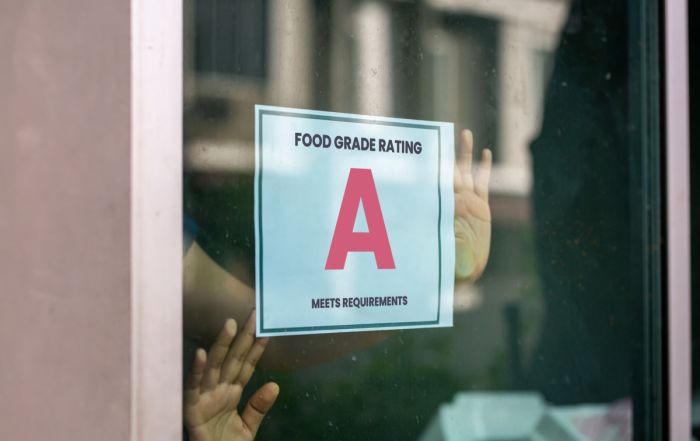
I generally try to stay away from controversial topics in my blog, but this is one I thought it might be interesting to discuss. Occasionally on my travels, I will come across a state or a local jurisdiction that requires foodservice inspection scores be posted in the window of the establishment. The idea is to allow would-be customers the ability to see how the foodservice operation in which they are about to eat scored on their latest health inspection.